All posts in “Uncategorized”

Three broken pieces of English toffee topped with milk chocolate and sliced almonds

English Toffee: How We Make It, and Why It Keeps

English Toffee: How We Make It, and Why It Keeps

The kitchen smells different in October. In July it is mostly sugar and cream and whatever ice cream flavor somebody just opened. By the middle of October, with the back door shut against the wind, the smell that fills the room is browning butter. That is toffee cooking, and it is the batch we pay the closest attention to all year.

We have been making candy by hand, in small batches, since 1977. Some of it is forgiving. Fudge will wait for you. Caramel will mostly wait for you. Toffee will not.

What English toffee actually is

Two ingredients carry it: butter and sugar. That is close to the whole list. There is no cream in it, which is what separates toffee from caramel. Caramel stays soft because of the dairy. Toffee gets cooked hotter and further, until the sugar goes past chewy and into brittle, and then it snaps.

Ours gets almonds and a layer of chocolate over the top. Bite through it and you get three things in order — the snap, then butter, then the toasted almond underneath. It is a loud candy. People eat it standing over the counter so the pieces do not get away from them.

The part where you cannot walk away

Butter and sugar go in the kettle together and come up slowly. For a while nothing looks like it is happening. Then the batch starts to change color, and once it starts it moves fast — pale gold, then honey, then the shade of a penny. That last stretch is maybe a minute wide.

You go by color and by smell more than anything. Pull it early and it will be soft and taste flat. Leave it thirty seconds long and the butter scorches, and there is no fixing that. You start over. Everyone who has made candy for a living has thrown out a batch of toffee and taken the lesson.

When it is right, it goes out onto the slab and gets spread thin while it is still moving. Chocolate goes on while the surface is hot enough to melt it, which is the trick — the chocolate marries into the toffee instead of sitting on top of it like a lid. Almonds go over that. Then it cools, and it sets up hard, and we break it into sheets by hand. The pieces come out uneven on purpose. A toffee piece cut square looks like it came out of a machine.
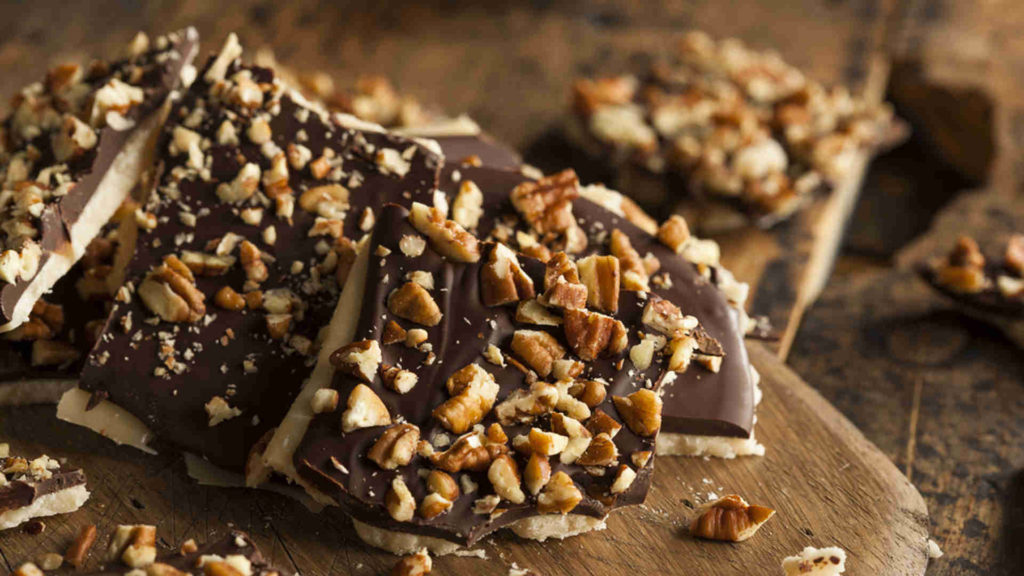
English toffee broken into uneven pieces, topped with chocolate and chopped nuts, resting on a wooden board

It travels better than anything else we make

This is the practical reason we make a lot of toffee once the weather turns. Toffee has no cream in it and nothing soft to go wrong. It does not bloom, it does not weep, and it does not mind a cold mailbox. Of everything in our cases, it is the piece we feel best about putting in a box and sending across the country.

We ship anywhere in the United States from our online store, and orders over fifty dollars ship free. If you are mailing candy to somebody for the holidays, order earlier than feels necessary. Everyone decides at the same time, and the last two weeks of December belong to the shipping companies, not to us.

There is a sugar-free version

Toffee is a hard candy to make without sugar, because sugar is most of the structure. Ours comes out close — the same snap, the same almonds, the same browned-butter flavor. It is usually in the case alongside the rest of our sugar-free selection. If you are driving a long way for it, call ahead, because sugar-free items sell out faster than we expect them to.
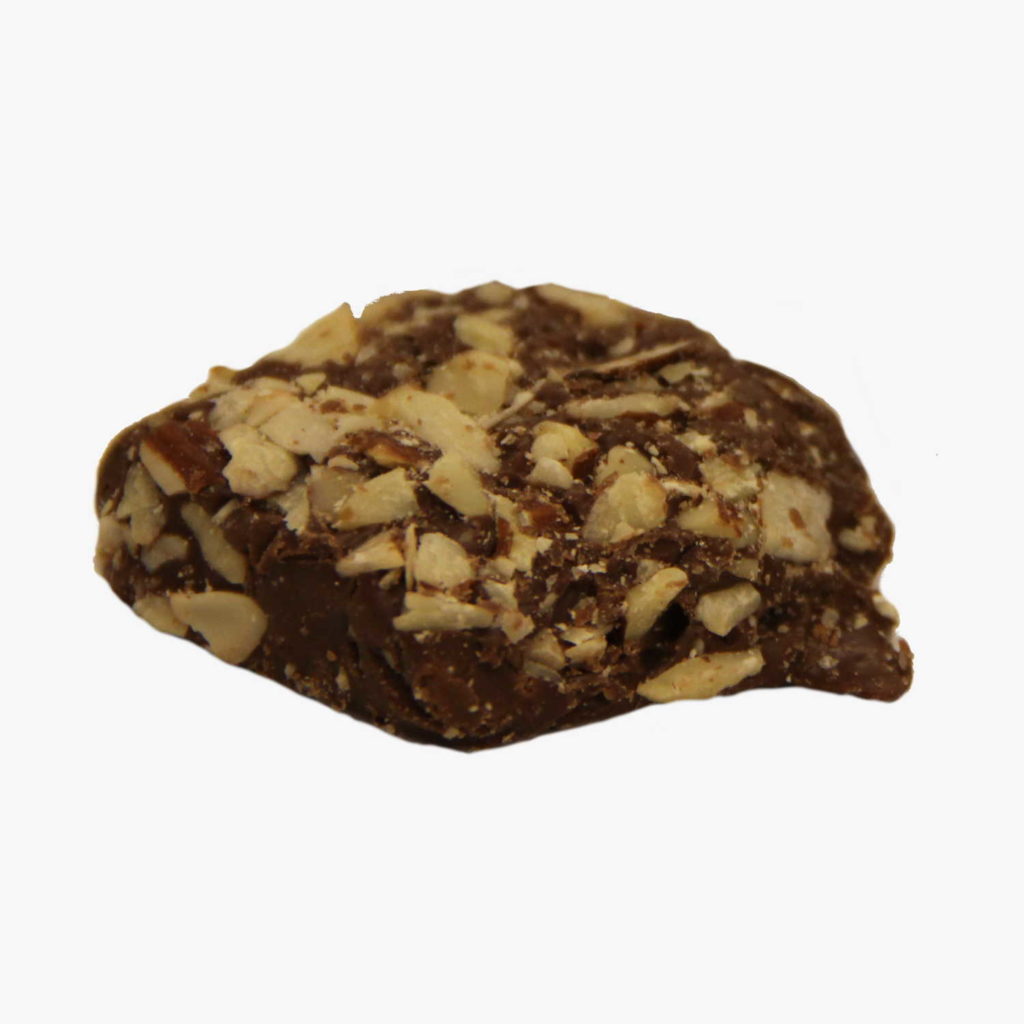
A single piece of sugar-free English toffee coated in milk chocolate and sliced almonds

Where to find it right now

Both shops have English toffee most days, though the calendar matters this time of year.

  • Keystone, 117 Winter Street — open spring through October, so these are the last days of the season. Hours get shorter as the month runs out and they move with the weather. Call ahead if you are making the drive.
  • Hill City, 205 Main Street — open year-round. Once Keystone closes, this is the shop, and the European-style coffee bar is here. A piece of toffee next to an espresso is the best five minutes of a cold afternoon.
  • Ice cream — still running at both shops while Keystone is open. Nobody believes us until they see somebody order a specialty sundae in a forty-degree breeze.

If you are wondering whether a late-fall or winter trip up here is worth it, the short answer is yes, and quieter. Mount Rushmore is open every day of the year except December 25, when the buildings close but the grounds stay open if the weather allows. The parking is easy. The viewing terrace is nearly empty some mornings. And Hill City is twenty minutes down the road with the lights on and the kettles going.

Come by on a cold day and ask what is on the slab. Most days in the next few months, the answer involves butter.

The Last Weeks of the Keystone Season

The Last Weeks of the Keystone Season

October is the quiet month in Keystone. The buses thin out, parking opens up on Winter Street, and the hillsides above town go gold where the aspen stand in among the pines. Mornings start cold enough that you want your hands around something warm. By two in the afternoon you are carrying your jacket.

It is also the last stretch of our season. The Keystone shop is open spring through October, and when the month runs out we clean the kettles, pack what is left, and move the whole operation up the road for the winter. If a trip to Keystone is on your list this year, these are the weeks.

What the shop is like right now

Better, honestly. In July you wait behind a family of nine deciding between maple nut and penuche. In October you walk up to the case and take your time. We still pour fudge most days, and the marble slab out front is still the best show in the shop — hot fudge spread thin, worked with a scraper until it loses its shine and starts to set.

The ice cream counter stays on until we close, which surprises people in a 45-degree breeze. Jumbo scoops, soft serve, malts, specialty sundaes. Plenty of folks order one anyway and eat it in the car with the heater running. That is a Black Hills tradition as much as anything else here.

One thing to know: our hours shorten as the month goes on, and they move with the weather and the traffic. Most days we are open well into the evening, but late in October it is worth a phone call before you drive up. Keystone is (605) 666-4675.

What to take home before the door closes

Everything we make keeps better than people expect, which makes the last visit of the season a good time to stock up.

  • Fudge. Cut thick off the slab. Chocolate and chocolate nut move fastest, but penuche — brown sugar, no cocoa at all — is the one that converts people.
  • Bear paws. Pecans or cashews or almonds, our own caramel poured over the top, then dipped. A Black Hills staple and usually the first thing a regular asks for.
  • Caramels. Cooked in copper, cut by hand, wrapped one at a time. The sea salt ones in dark chocolate are the ones we hear about.
  • Taffy. Buy a bag, forget it in the glove box, find it in January, and it is still good.
  • English toffee. Buttery and brittle under the chocolate. It travels well and it keeps.

There is a full sugar-free selection too — clusters, caramels, toffee, bear paws — for the people in your group who usually stand by the door and wait.

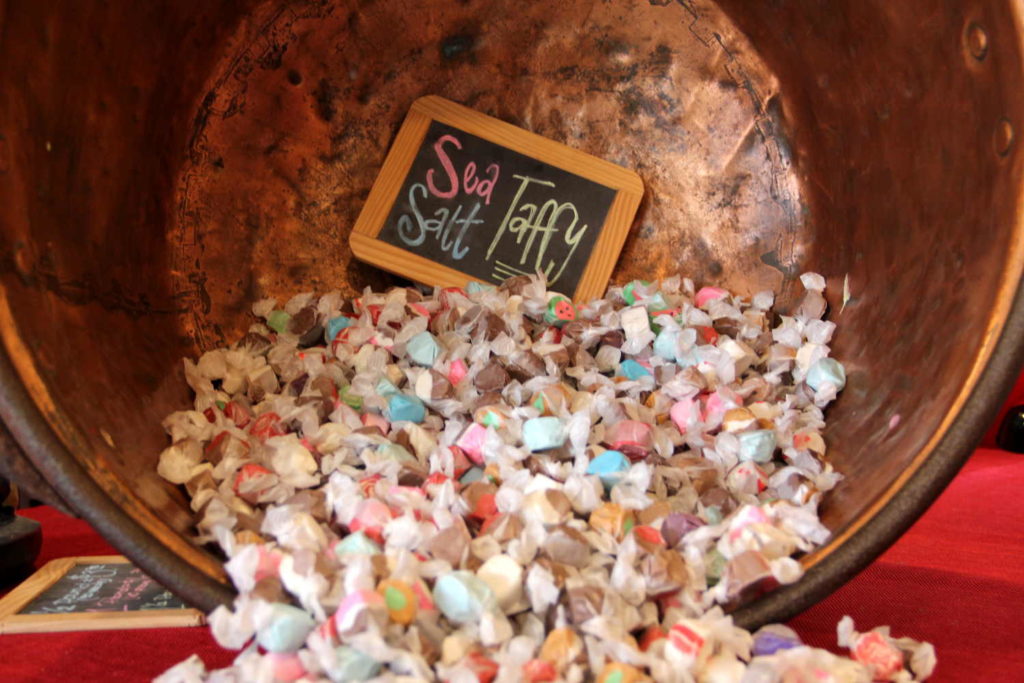
Wrapped sea salt taffy spilling from a large copper kettle beside a small chalkboard sign reading Sea Salt Taffy

The roads close before we do

If you are building a drive around the visit, check the roads first. South Dakota Game, Fish and Parks says the Needles Highway closes to vehicles with the first snow of the season and does not reopen until April 1, or later depending on conditions. Iron Mountain Road stays open longer but closes off and on through the winter, depending on how fast the plows can get it cleared.

Mount Rushmore itself is the steady one. The National Park Service keeps the memorial open every day of the year except December 25, though the buildings and programs run on shorter winter hours starting in November. Worth checking the park’s own hours page the week you travel rather than trusting a schedule you saw in July.

We are just down the hill from the memorial. Most people come down off the mountain, find the light fading, and want something sweet before the drive back to Rapid City. That is most of our October afternoons.

After October, find us in Hill City

When Keystone closes for the winter, our Hill City shop keeps going. It is open year-round at 205 Main Street, and it is the one with the European-style coffee bar — espresso, cappuccino, a quiet table by the window while the snow comes down on Main Street. Same fudge, same bear paws, same ice cream counter. The slab out front runs all winter.

The brick storefront of the Turtle Town shop at 205 Main Street in Hill City, South Dakota, with red and white striped awnings and a gold Turtle Town Coffee and Fudge sign

Hill City stays busier in the off-season than people assume. The 1880 Train runs out of Hill City from May through December, the galleries stay open, and November and December bring the kind of weekend where a warm shop with a coffee machine is exactly where everybody ends up.

Or we put it in a box

If you are not getting back out here before spring, our online shop ships anywhere in the United States, and orders over $50 ship free. Fudge, bear paws, caramels, truffles, toffee, taffy, the sugar-free selection — all of it, packed the same week it is made.

We have been making candy by hand, in small batches, since 1977. Some years that means a July line out the door. Some years it means a Tuesday in late October with four people in the shop and the whole counter to yourself. We like both, but the second one is a little easier to recommend.

Cream Caramels.

The Two-Dollar Candy That Outsells Everything Else

The Two-Dollar Candy That Outsells Everything Else

People ask us fairly often what our best seller is. They usually expect the answer to involve chocolate. It doesn’t. The single most popular thing in the case is a plain cream caramel, sold by the piece for two dollars, with nothing on it at all.

It has been that way for a long time. We have been making candy by hand, in small batches, since 1977, and the caramel is the piece that quietly outsells the showier things sitting next to it.

What a cream caramel actually is

Caramel is a simple idea done slowly. Sugar, cream, butter, time. The cream is what separates a candy-shop caramel from the kind that comes in a plastic bag. It gives you a center that stays soft and buttery instead of turning into a workout for your jaw.

You can tell within the first bite. A good cream caramel gives way, then lets go slowly. It is rich without being cloying, and chewy without pulling a filling. That is the whole trick, and there is no shortcut to it — the batch takes as long as it takes.

We sell the cream caramel by the piece, which is either the perfect small treat or a rookie mistake. Most people who buy one buy several the next time.

Then we start dipping them

The same center goes in a lot of directions once chocolate gets involved, and each one tastes like a different candy.

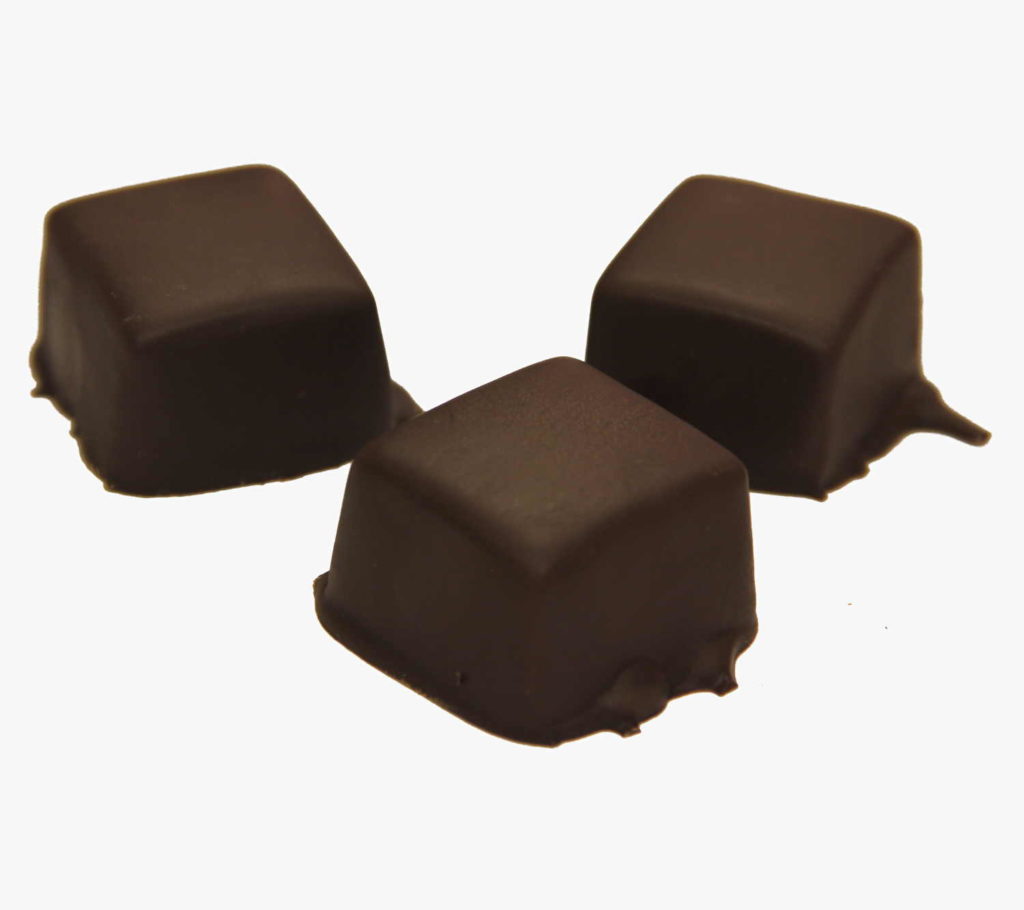
Three hand-dipped dark chocolate caramels on a white background

Dipped in milk chocolate, you get the classic — soft center, chocolate that snaps just enough before the whole thing melts together. It is the safest gift in the store. Nobody has ever handed one back.

Dipped in dark chocolate, the sweetness pulls back and the butter comes forward. People who say they don’t like caramel often mean they don’t like sweet. This is usually the one that changes their mind.

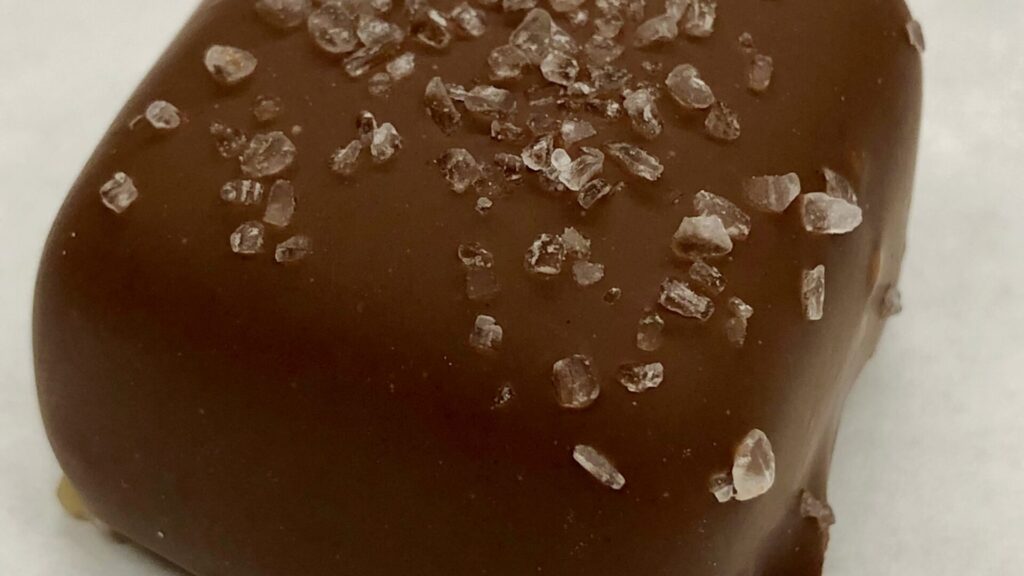
Close-up of a chocolate-dipped sea salt caramel topped with coarse salt crystals

Then there is sea salt. A pinch of coarse salt on top of the chocolate sharpens everything underneath it and makes the caramel taste more like caramel. The dark chocolate sea salt caramel is the grown-up version; the milk chocolate one is its sweeter sibling. Buying a few of each is the honest way to settle the argument.

If you want the caramel worked into something bigger, it also turns up in our caramel pecan fudge and in the bear paws, where it sits between pecans and chocolate.

October is the last month in Keystone

Our Keystone shop at 117 Winter Street runs spring through October, so this is the stretch where people come through and stock up before we close for the winter. If you are heading up to Mount Rushmore this month, the memorial’s grounds and visitor center are on fall hours, 8 a.m. to 5 p.m., and the evening lighting program starts at 5 p.m. beginning October 1 — worth checking the park’s hours page before you go.

Keystone is a short walk of a town, which is the nice part. You can see the faces, come back down the hill, and be holding a caramel twenty minutes later.

The Turtle Town storefront at 205 Main Street in Hill City, South Dakota, with red and white striped awnings and a brick facade

Once Keystone closes, Hill City carries the winter. The shop at 205 Main Street is open year-round, with the coffee bar going and the candy case full, and it stays that way through the quiet months when the highways empty out. Hours shift with the season, so call ahead if you are making a special trip.

If you can’t get here

Caramels travel well, which is not true of everything we make. They ship anywhere in the U.S., and orders over $50 ship free. Most people who order start with a box of the milk chocolate ones and add a few sea salt pieces to see what all the fuss is about.

It is also the time of year to start thinking a few weeks ahead. The holiday shipping window fills up faster than anyone expects, and caramel keeps better than most candy. You can see the whole case in our online shop.

Either way, if you do make it through the door, get the plain one first. Two dollars is a cheap way to find out why it outsells everything else.

A Fall Color Loop from Keystone to Hill City

A Fall Color Loop from Keystone to Hill City

Late September in the Black Hills smells like pine and cold creek water, and the aspens are starting to go gold along the high roads. If you have one free day this fall, spend it on the loop that begins at our Keystone front door and ends at our Hill City one.

The timing is good right now. Fall color in the Hills usually peaks from late September into early October, with the higher elevations turning first and the valleys holding their color into mid-October. One guide we like puts the sweet spot at September 25 through October 10. That window is open.

Morning: Iron Mountain Road out of Keystone

Start early. The light is softer, the pullouts are empty, and you will want a jacket until the sun gets over the ridgelines.

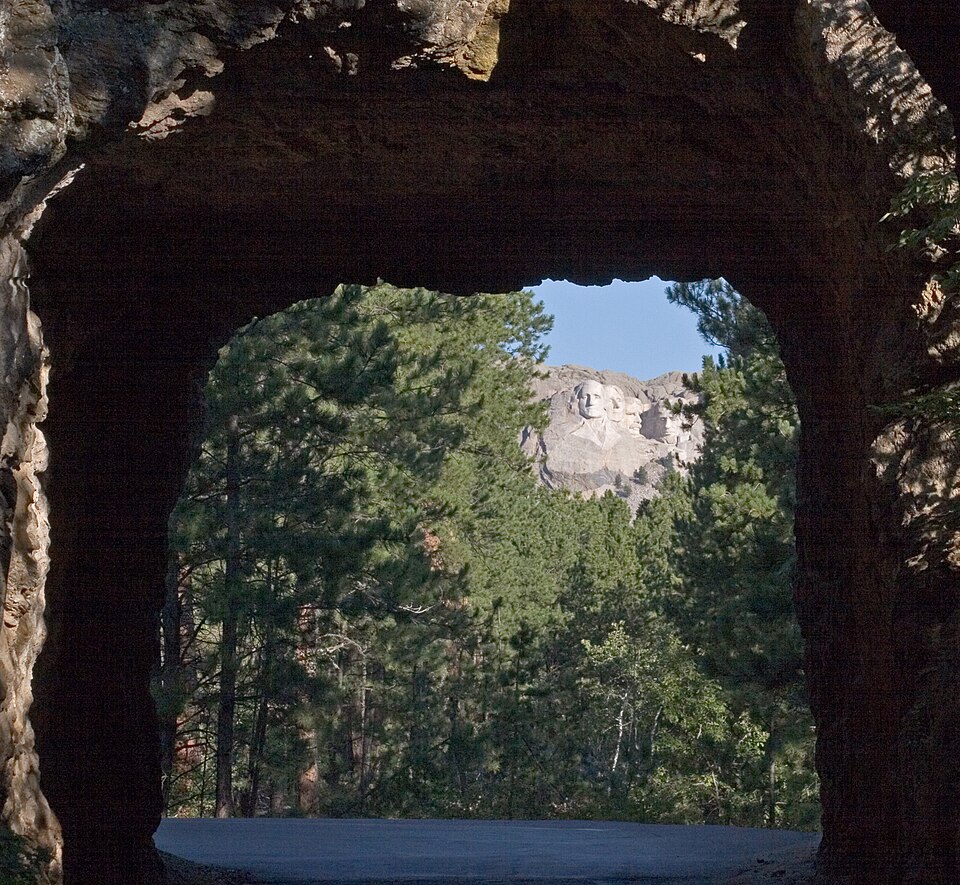
Iron Mountain Road (US 16A) leaves Keystone heading south and runs 17 miles of curves toward Custer State Park. It is the road with the pigtail bridges, those wooden corkscrews that let you drop or gain altitude in a hurry, and three rock tunnels. The tunnels are cut so that Mount Rushmore sits framed in the opening, far off in the distance. Heading south, use the pullouts and look back toward the mountain. With yellow leaves in the foreground, it is the picture people take home.

Mount Rushmore framed in the opening of a rock tunnel on Iron Mountain Road in the Black Hills of South Dakota
Mount Rushmore framed by one of the Iron Mountain Road tunnels. Photo: Kimon Berlin, CC BY-SA 2.0, via Wikimedia Commons

Give it at least an hour. Nobody drives Iron Mountain Road fast, and nobody should.

Midday: the Needles and Sylvan Lake

Iron Mountain Road and the Needles Highway are two pieces of the Peter Norbeck Scenic Byway, named for the South Dakota senator and conservationist who planned and surveyed most of the roads in Custer State Park.

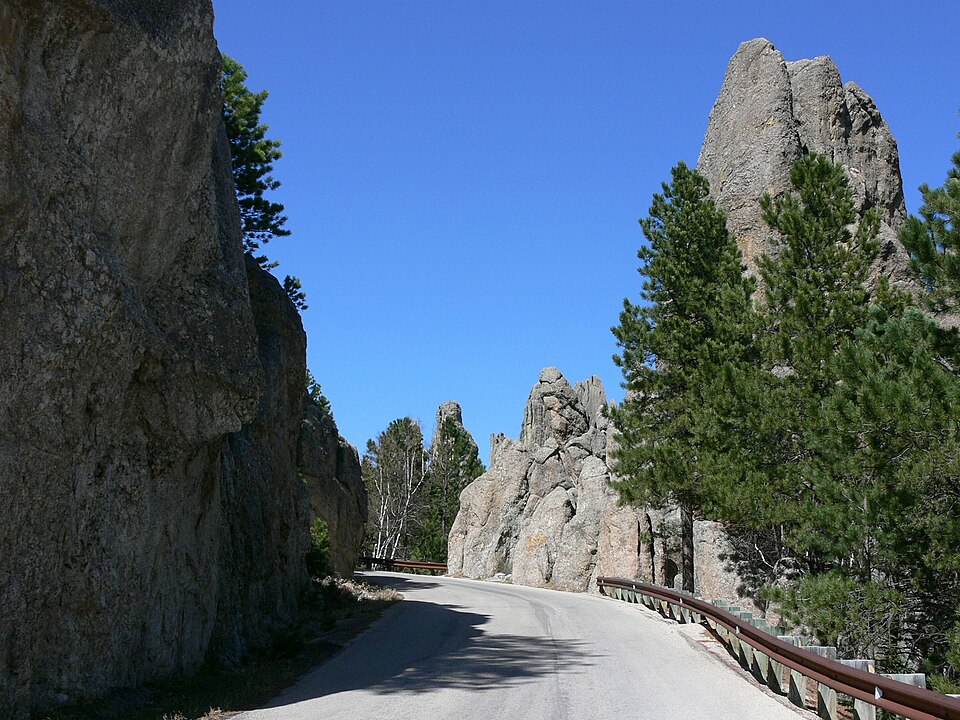
The Needles Highway (SD 87) is 14 miles of granite spires, tight switchbacks and two narrow tunnels. The Needles Eye Tunnel is 8 feet wide and 9 feet 9 inches high, so if you are traveling in a big pickup, a trailer or an RV, measure before you go. Plan on an hour or more here too, longer if you stop for every spire that catches the light, and you will.

The Needles Highway winding between tall granite spires and ponderosa pines in Custer State Park, South Dakota
Granite spires along the Needles Highway. Photo: U.S. National Archives (public domain)

A few things worth knowing:

  • The loop passes through Custer State Park, which requires a park entrance license. Details are on the South Dakota Game, Fish and Parks website.
  • The Needles Highway closes to vehicles with the first snow of the season and does not reopen until April 1 or later. In the Hills, that first snow can come without much notice, so if this drive is on your list, sooner beats later.
  • If you are in the area Friday, September 25, the Custer State Park Buffalo Roundup brings about 1,300 bison thundering in off the prairie, with the Arts Festival running September 24 through 26. Expect more traffic in the park that week.

The Needles spill out near Sylvan Lake, which is the right place for a long lunch. The water holds the reflection of the rocks and the turning trees, there is an easy trail around the shore, and if you have the legs, the trail to Black Elk Peak starts here too.

Sylvan Lake in October with golden aspens and granite boulders reflected in still water, Custer State Park, South Dakota
Sylvan Lake on an October morning. Photo: Pahcal123, CC BY-SA 4.0, via Wikimedia Commons

What to pack for the road

The full byway takes three to four hours of driving, and most people turn it into a whole day. That means snacks, and we have opinions about snacks.

We have been making candy in the Hills since 1977, and a good share of what leaves our shops in the fall ends up riding shotgun on these roads. Fudge travels well. So do caramels, toffee and our bear paws: pecans, soft caramel and chocolate, made by hand in small batches the same way they have been for decades. A bear paw eaten at a Needles Highway pullout, with the air cold enough that the chocolate stays firm and snaps a little, tastes about as good as candy gets. If you are traveling with someone watching their sugar, we make sugar-free candy too, and our coffee and tea bar is there for those chilly early starts.

Our advice is simple: stop at the Keystone shop on your way out in the morning, and save room for the Hill City shop on the way home.

Evening: Hill City, and one last look at Rushmore

From Sylvan Lake it is a short drive north to Hill City, where the loop ends on Main Street. It is a good place to walk off a day in the car, and the pace slows down once the summer crowds thin out.

If you still have energy after dinner, Mount Rushmore is lit every night of the year. The ranger-led evening lighting program, though, runs only through the end of September, so this is the last week to catch it before it wraps for the season. After that, the sculpture is still illuminated after dark, just without the program.

Come see us this fall

Our Keystone shop stays open into the fall before closing for the winter, and our Hill City shop is open all year, so whichever end of the loop you start from, the kettles will be going. Stop in, say hello and let us know how the leaves looked up high. We always want to hear.

Turtle Town Keystone, 117 Winter St · Turtle Town Hill City, 205 Main St

A Fall Weekend in Hill City

A Fall Weekend in Hill City

The Hills change fast in the last week of September. One weekend the aspen up on the high roads are still green, and by the next the whole draw has gone yellow. If you are trying to pick a weekend to come see it, here is how the next month lays out from where we sit on Main Street.

The color comes in from the top down

Most Black Hills fall-color guides point at roughly September 25 through October 10 as the window worth planning around. The high country turns first — aspen going yellow, sumac going red along the road cuts — while the lower valleys hold their color into the middle of October. That spread is good news for anyone who can only get away one weekend. There is usually somewhere in the Hills doing something worth the drive.

The classic loop out of Hill City runs south and east: Needles Highway on SD 87 with the leaves framing the granite, Sylvan Lake where the water doubles the view, the Wildlife Loop through Custer State Park, and Iron Mountain Road on the way back with its tunnels lined up on Mount Rushmore. It is not a fast drive and it is not meant to be. Give it most of a day, check road conditions before you go, and pack a jacket, because the mornings up there have started to bite.

Main Street becomes a finish line October 3 and 4

The first weekend of October, Hill City hosts Run Crazy Horse. Saturday, October 3 brings the Fast 5K and the Kids 1K, both point-to-point downhill on the Mickelson Trail. Sunday, October 4, the marathon and half marathon start at 8 a.m. at the Crazy Horse Memorial visitor center and run north, finishing on Main Street in front of the Bumpin’ Buffalo. There is also a five-person relay for people who would rather split the distance with friends.

If you are not running, this is still a good weekend to be in town. The course stays open seven hours and the race encourages walkers on both the half and the full, which means the last finishers come in well into the afternoon and the street stays busy most of the day. Main Street is only a few blocks long. Find a spot along it, and the whole race comes to you.

Earlier in the month, the calendar is already full

Two weeks before that, the Mickelson Trail Trek runs its three riding days, September 18 through 20 — Custer to Edgemont at 44.5 miles, Custer to Rochford at 39.5, and Rochford to Deadwood at 24, about 109 miles of old rail grade all told. It is a supported ride, and the towns along the trail feel it.

Then, on Friday, September 25, the Custer State Park Buffalo Roundup. Parking lots open at 6:15 a.m., and the recommendation from the park has never changed: get there early. Roughly 1,300 bison get moved by riders on horseback while a few thousand people watch from the hillsides, and it is loud in a way that photographs do not capture. The Buffalo Roundup Arts Festival runs alongside it, September 24 through 26, with more than a hundred vendors. There is no entry fee for the roundup itself, though a park entrance license is required on the surrounding days.

That Sunday, September 27, Crazy Horse Memorial holds its autumn Volksmarch — a 10-kilometer hike, with a 5K option, and one of the few days each year the public walks up onto the mountain. Registration opens at 7 a.m. and hikers start any time before 1 p.m. It is a popular one, so expect company.

The middle of the day is the best part

Somewhere in every one of those weekends there is an unscheduled hour. The color drive is done and the light is wrong for photographs. The race has an hour left in it. The kids are cold. That hour is the reason a lot of people wander into a candy shop on Main Street, and we have been happy to be that stop since 1977.

Most of what we sell gets made a batch at a time in copper kettles, the same way it was when the shop opened. Caramel cooked slow and poured out to set. Fudge worked on marble until it loses its shine and turns creamy. Bear paws — pecans, caramel, and chocolate, in that order, which is the only order that works. There is coffee and tea if you need the warm cup more than the sugar, and ice cream for the people in your group who will order it in October anyway.

We keep two shops. Hill City, at 205 Main Street, is open year-round, which matters more in the fall than it does in July. Keystone, at 117 Winter Street, runs roughly March through October, so if Keystone is on your route, this is the stretch of the year to catch it.

Come find us

Whether you are here for the bison, the leaves, the finish line, or none of the above, both shops are on the way. Stop in, watch a batch get made if the timing is right, and take something home for the drive.

Turtle Town — Hill City, 205 Main Street · Keystone, 117 Winter Street

Looking for a Candy Shop Near Rapid City? It’s a Short Drive Up the Hill

Looking for a Candy Shop Near Rapid City? It’s a Short Drive Up the Hill

Every summer, plenty of people in Rapid City search for a candy shop and come up mostly empty downtown. Here’s the honest local answer: the old-fashioned candy shops are up in the Hills, and one of them has been at it since 1977. We’re Turtle Town, we make everything by hand in small batches, and depending on which of our two shops you point the car at, we’re about thirty to forty minutes from Rapid City — usually on the way to somewhere you were already planning to go.

How far is it, exactly?

Our Keystone shop at 117 Winter Street is the close one — roughly a half-hour drive from Rapid City, straight out Highway 16 toward Mount Rushmore. If Rushmore is on your list, we’re three miles from the monument, so a candy stop adds almost nothing to the trip.

Our Hill City shop at 205 Main Street is a bit farther, closer to forty minutes, and it’s the one that stays open all year. Hill City’s Main Street also has the 1880 Train depot, galleries, and the Mickelson Trail, so the drive earns its keep even before the fudge.

What’s in the case when you get here

Both shops make candy the way it was made when the Keystone store opened in 1977: in small batches, by hand.

Fudge comes in thirteen flavors, worked on the marble slab — chocolate, penuche, maple nut, caramel pecan, and the rest of the case. Bear paws — pecans, caramel, and chocolate — are the Black Hills classic and the thing regulars ask for first. Beyond that there are hand-dipped truffles, sea salt caramels, toffee, salt water taffy, and a full sugar-free selection. Both shops also scoop ice cream — jumbo scoops, malts, and specialty sundaes — which settles most arguments about whether the kids ride along.

Make it part of a Black Hills day

Almost nobody drives out from Rapid City just for candy, and they don’t need to. Keystone pairs with Mount Rushmore and the Iron Mountain Road. Hill City pairs with the 1880 Train, Crazy Horse Memorial, and Custer State Park. Either way, the candy stop slots neatly between the big sights — and a box of fudge rides home better than most souvenirs.

Can’t make the drive?

We ship. Fudge, taffy, chocolates, and gift boxes go anywhere in the U.S. through our online store, and orders over $50 ship free. In the warm months we pack for the weather.

Come see us

Turtle Town Keystone — 117 Winter Street, Keystone, SD, open spring through October.
Turtle Town Hill City — 205 Main Street, Hill City, SD, open year-round.

Hours shift with the season, so if you’re making a special trip in the shoulder months, a quick call ahead is a good idea. Otherwise, just come up the hill. There is usually something still warm.

What Is Penuche? Our Brown-Sugar Fudge, Explained

What Is Penuche? Our Brown-Sugar Fudge, Explained

Stand at our fudge counter long enough and you’ll hear the same question a dozen times: what’s penuche? It’s the light-brown slab sitting in the case among the chocolates, and it has been there since our Keystone shop opened in 1977. The short answer: it’s fudge made with brown sugar instead of chocolate. The longer answer is worth a minute, because penuche quietly does more work in our shop than any other flavor.

So what is penuche, exactly?

Penuche is brown-sugar fudge. There’s no chocolate in it at all — just brown sugar, butter, milk, and vanilla, cooked and beaten the same way as any other fudge. What sets it apart is the molasses that brown sugar carries with it. Cooked down, it lands somewhere between caramel and butterscotch: deep, buttery, a little toasty. The texture is pure fudge, smooth and dense, but the flavor is what an old candy maker would have simply called brown-sugar candy.

People who grew up with penuche tend to spot it across the room. People who didn’t usually ask for a taste, and then leave with a slice of Penuche Fudge anyway.

One candy, half a dozen spellings

Penuche is the usual spelling, but depending on whose cookbook you’re reading you’ll also see penuchi, panocha, panoche, or panuche. The name is generally traced back to a Spanish word for raw sugar, and the candy itself became a fixture of New England kitchens well over a century ago, handed down through church and community cookbooks. In some families it’s simply “brown sugar fudge,” and that works too. Out here in the Black Hills we call it penuche — but if you ask for the brown-sugar one, we’ll know exactly what you mean.

How we’ve made it since 1977

Our penuche is made like every other fudge in the case: in small batches, right at the shop, the old-fashioned way. Brown sugar and butter don’t leave a candy maker much room to hide. Cook the batch a touch short and it won’t set; take it a touch long and it turns crumbly instead of creamy. Getting it right is mostly patience and practice, and after nearly fifty years of batches we’ve had plenty of both.

The quiet workhorse of our fudge case

Here’s the part most folks don’t know: penuche isn’t just one flavor among our thirteen. It’s the foundation for two of the others.

Our Caramel Pecan Fudge is built on a penuche base — that same brown-sugar fudge, loaded up with pecans. Brown sugar and pecans is about as natural a pairing as candy gets, which is why that one rarely sits in the case for long.

And our German Chocolate fudge is half penuche, too. It’s a two-layer fudge, and the “frosting” side — the layer that plays the part of the rich frosting on a German chocolate cake — is penuche. So if you’ve tried either of those and liked what was going on underneath, you’ve already had penuche. You just didn’t know its name.

Try it plain, or in disguise

You’ll find penuche in the fudge case at both of our shops — 117 Winter Street in Keystone and 205 Main Street in Hill City — alongside the Caramel Pecan and German Chocolate it holds together, and the rest of our small-batch fudge flavors. If your Black Hills trip is already behind you, we ship fudge anywhere in the U.S.

Either way, next time you see a light-brown slab you don’t recognize in a fudge case, you’ll know: that’s penuche, and it’s been earning its spot since 1977.

When NewsCenter1 Needed a Chocolate Fix

When NewsCenter1 Needed a Chocolate Fix

A while back, the folks at NewsCenter1 in Rapid City featured our shop in their Connect With Us series, under a headline we have no argument with: “Need a chocolate fix? Turtle Town is for you!”

Better yet, the segment itself is on NewsCenter1’s YouTube channel — here it is:

For anyone who found us through it, or anyone wondering what a camera crew finds when it walks into a candy kitchen in the Black Hills, here’s the honest tour.

What the cameras see

The first thing is the smell, which unfortunately doesn’t broadcast. Chocolate tempering in the melters, caramel cooking in copper kettles, and on a good morning, English toffee cooling on the marble slab. We’ve been making candy this way since 1977 — small batches, dipped and finished by hand, no shortcuts that would make the work easier and the candy worse.

The case up front holds what the kitchen turned out that week: sea salt caramels finished with flake salt, a long row of truffles, fudge cut thick, taffy pulled in more flavors than strictly necessary, and our bear paws — pecans, cashews, or almonds under caramel and chocolate, the thing people drive back into the Hills for. There’s a sugar-free case too, because nobody should have to sit out a candy store.

Two shops, one kitchen

Visitors sometimes meet us twice without realizing it. The Hill City shop at 205 Main St is the year-round home base, four miles from Mount Rushmore as the crow flies and a good deal prettier the long way. The Keystone shop at 117 Winter St opens for the season, three miles from the mountain, for everyone who worked up an appetite looking at four presidents.

We’re grateful every time someone points a camera or a pen our way — it’s a long way from a copper kettle in Hill City to a news broadcast. But the best way to cover this story has always been in person. Come get your chocolate fix; we’ll be at the kettles.

The Day KOTA Came to Hill City for Chocolate

The Day KOTA Came to Hill City for Chocolate

Every so often somebody asks how a town of under a thousand people gets a news crew to drive out in the middle of February. The answer, at least once, was chocolate.

Back in February 2024, KOTA TV came to Hill City on a weekend when two things were happening at once: the Polar Bear Chili Cookoff at the Tin City Masonic Lodge, with about twenty teams ladling out their best, and our own Tour de Chocolate, the weekend we send trays of handmade treats to businesses up and down Main Street so visitors can walk the town and taste their way through it. The story they ran, “Two Hill City events coincide to bring visitors to local businesses,” made the point better than we could: when a small town puts two good reasons to visit on the same weekend, everybody’s door swings a little more often.

What April told them

Our general manager, April Purdie, talked with KOTA about why we keep sponsoring the tour year after year. As she put it, “we love giving back to those who come see us all year long.” That’s really the whole idea. The people walking Main Street in February parkas are our neighbors and our regulars — the ones who keep a candy shop going through a Black Hills winter — and one weekend a year the chocolate is simply on us.

What Tour de Chocolate actually is

If you’ve never been: each February, participating Hill City businesses set out free chocolate from our kitchen. You wander shop to shop, warm up, browse, and eat chocolate. There is no catch. The caramels, fudge, and bear paws on those trays come out of the same copper kettles as everything in our case, made by hand a few blocks away, the way we’ve done it since 1977.

The chili cookoff and the chocolate tour still land close together most winters, and between the two of them, a February Saturday in Hill City is a better time than it has any right to be. Watch this space toward the end of January for the next tour’s dates.

And if February feels too far away, the case is full right now — stop in and see us at 205 Main St in Hill City, open year-round, or at 117 Winter St in Keystone during the season.

After Labor Day: A Black Hills September Guide

After Labor Day: A Black Hills September Guide

Labor Day gets treated like a closing bell around here. It isn’t. The three weeks that follow are some of the best the Black Hills have all year, and the calendar between now and early October is fuller than most people expect.

The first two weekends belong to Hill City and the trail

The Hill City Quilt & Fiber Arts Show runs September 12 and 13 at Hill City High School, 9 a.m. to 4 p.m. both days. Admission is $7 at the door and free for anyone under 18. It is the kind of show where you walk the aisles slowly, and where somebody’s grandmother will explain a stitch to you whether you asked or not.

The following weekend the trail takes over. The 28th annual Mickelson Trail Trek runs September 18 through 20, covering the whole 109 miles of the George S. Mickelson Trail in three days: Custer to Edgemont on Friday, 44.5 miles; Custer to Rochford on Saturday, 39.5 miles; Rochford to Deadwood on Sunday, 24 miles. Riders base out of Custer for the first two nights and finish in Deadwood. If you are not riding, you will still notice it — the towns along the trail fill up with people who have been on a bicycle since breakfast and are ready to eat something.

Roundup weekend, and the hike that follows it

The Custer State Park Buffalo Roundup and Arts Festival lands September 24 through 26, with the roundup itself on Friday the 25th. Riders push roughly 1,300 head of bison across the open grassland while spectators watch from the viewing areas. Parking lots open at 6:15 a.m., which sounds unreasonable until you have sat in the dark with a cup of coffee and watched the light come up over that valley. A park entrance license is required on the 24th and the 26th, but not on roundup day itself. The arts festival runs alongside it with vendors selling work made by hand.

Then, on Sunday the 27th, Crazy Horse Memorial opens the mountain for the autumn Volksmarch. Registration starts at 7 a.m., hikers can set out anytime between 8 a.m. and 1 p.m., and the trail closes at 4 p.m. There is a 5K and a 10K, the longer one running about 6.2 miles round trip with a good deal of climbing. The American Volkssport Association charges $4, cash or check, and memorial admission is waived for hikers who bring three cans of food. Two of the biggest weekends of the Black Hills year, back to back, after the summer crowds have gone home.

The color comes down the hill

Fall in the Hills works from the top down. The high country turns first, generally somewhere in the middle of September, and the lower ground follows a week or two behind — so the color window stretches from mid-September into mid-October rather than arriving all at once. Aspen and birch do most of the work, gold against all that dark pine and spruce.

The Peter Norbeck Scenic Byway is the drive to take if you only take one. Needles Highway and Iron Mountain Road are on it, tunnels and switchbacks and the kind of pullouts that make everyone in the car go quiet. Give yourself twice the time the map suggests. You will stop more than you plan to.

One thing worth knowing before you build an evening around it: the ranger-led evening lighting program at Mount Rushmore runs nightly through the end of September. After that the sculpture is still lit each night, but the talk and the film wrap up for the season.

What changes behind our counter

The shop feels different in September, and not only because the line is shorter. Fall air is dry, and dry air changes candy. Caramel comes off the fire at a slightly different place. Fudge sets up faster on the marble than it did in July, which is a small thing that anyone who has worked a kettle in August will tell you is not a small thing. We have been making candy in these hills since 1977, in copper kettles, in batches small enough that a change in the weather is something you can taste.

The ice cream case starts sharing the room with the coffee. And the bear paws — pecans, caramel, and chocolate, made by hand the way they have always been made — go from something people grab on a hot afternoon to something people buy a box of for the drive home. That is the September rhythm. Fewer people, more time to talk to each of them.

Our Hill City shop at 205 Main Street is open year-round, which means it is there for the roundup crowd, the fall color drivers, and the quiet Tuesday in November when you just want fudge. The Keystone shop on Winter Street is seasonal, so if you are coming late in the fall, a quick phone call ahead is a good idea.

One more weekend, and it ends on Main Street

Run Crazy Horse takes place October 3 and 4, with a 5K, a half marathon, a marathon, and a relay. It starts in the shadow of the mountain carving and finishes in Hill City. Runners come down Main Street to the end of it, which puts a few thousand very hungry people on the same block we have been standing on for decades. We tend to be ready.

If you are planning any of this, plan for cold mornings and warm afternoons and a jacket you will take off by ten. And when you are in town, stop in. Turtle Town is at 117 Winter Street in Keystone and 205 Main Street in Hill City. There is usually something still warm.

Shipping PolicyReturns & RefundsPrivacy Policy